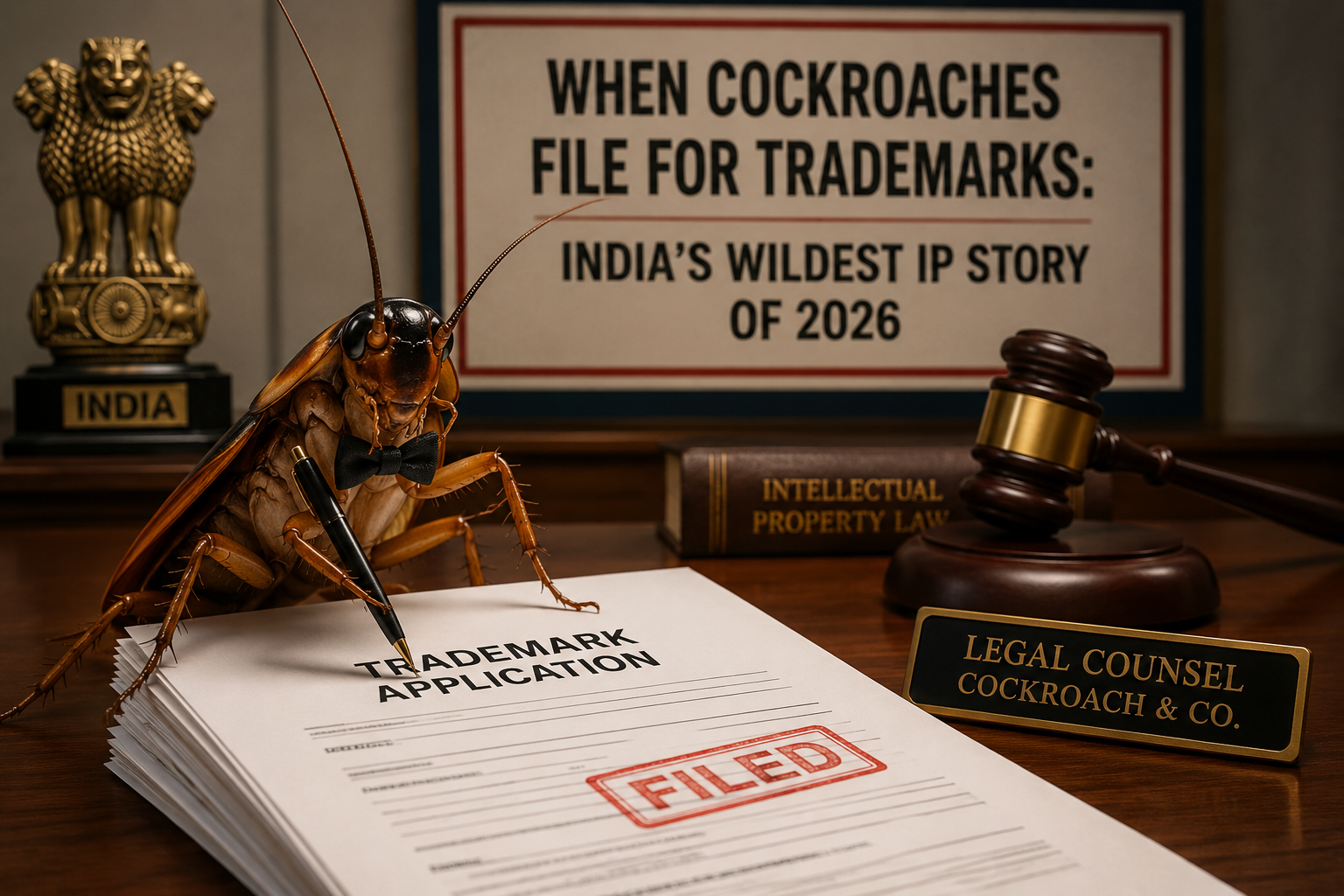
What began as a
joke is now turned into a massive political movement, depicting a perfect
online mobilizing movement led by youth upon the remarks given by Chief Justice
of India, Mr. Surya Kant referring unemployed youth as “cockroach”. What began as a joke is now part of one more Gen-Z led movement across
the globe. Capitalizing on the movement, Mr. Abhijeet Dipke brought all
eyes on a political spoof by creating Cockroach Janta Party, certifying a
three-point eligibility criterion for joining the same on social media
platforms. The membership within the Cockroach Janata Party demanded adherence to an elegantly uncomplex and
profoundly sardonic benchmark of eligibility, including status of employment to be unemployed, no
fanciful a ton of degree required, secondly, standard of activity to be lazy as
clarified by the CJI that he was referring to those youth who are lazy and
sitting on seats without qualification, and since it was an online movement, it
required the joiners to be text online warriors. As soon as the news took a
storm on the internet, it attracted many people for filling the word-mark for
the same in the current situation. There are four applications filled by different
people under class 45 as per Nice classification. The status of the same is formalities check pass, and of that of Dheeraj Kumar (7747574) is marked for exam
|
7737937 by AZIM ADAMBHAI JAM
|
COCKROACH JANTA PARTY
|
|
7741481 by
AKHAND SWAROOP
|
Cockroach Janta Party
|
|
7746568 by DEVENDER GANDHI
|
COCKROACH JANTA PARTY
|
|
7747574 by DHEERAJ KUMAR
|
COCKROACH JANTA PARTY
|

The wordmark
attracted attention across India as soon as the social media movement went
viral on the internet, paving the way for unconventional or controversial
trademarks in modern day branding, tapping into the modern and cool merchandise market potential
Prior to decoding
the analysis of registrability of the said trade mark, it becomes important to
first examine the principles of jurisprudence under which the law of trade mark
registration in India operates. Law of trade mark in India has seen a paradigm
shift over the years. The law relating to trade marks in India has moved from
being purely protectionist and based around traditional source identifying
marks to a more pragmatic and commercially aware approach to branding and
perception. The passing of the Trade Marks Act, 1999, in consonance with
the TRIPS Agreement obligations, has widened the ambit of what is considered registrable
as a mark with a liberal approach adopted in Section 2(1)(zb) and
stressing the ability of the mark to distinguish the goods or services of one
business organization from another. Thus, the concept of registrability of
marks in today's scenario has been defined not only on the grounds of
conventional concepts but also in accordance with distinctiveness, source
identifier, consumer perception, and prohibited grounds of Sections 9 and 11
Legal Framework
Governing Trademark Registration in India
Prima facie
purpose of protection of trademark is monopolizing brand identity and
preventing likelihood of confusion by granting exclusivity over business and
trade related rights. Trade mark includes catchy logos, specific signs, name,
ticket word, letter, numerals, shape of goods, packing or combination os colors or a
combination as defined in 2(m). Essential elements of trade mark are
dealt under section 2(zb)
of Trade Mark Act 1999 the first being mark should be capable of
geographical representation, secondly there should be distinguishing traits
which help in bifurcating one mark for other and may include shape of goods and their packaging and
combination of colour and not single colour. Trade mark registration also serves the purpose of legal protection
against infringement, providing statutory as well as common law remedy of
passing of in section 29 and 28 accordingly of Trademark Rights 1999.
The granting of
trade mark has to qualify the pre refusal stage and post grant stage including
relative ground and absolute grounds of refusal under section 9 and section
11 of Trademark Act. Absolute vs.
Relative Grounds for Refusal Trademark registries use two different legal
frameworks, absolute grounds and relative grounds, to assess the validity of a
trademark application. Absolute grounds ignore market competition in favor
of examining the mark's intrinsic qualities. In nations like India, Section
9 of the Trade Marks Act, 1999 primarily governs this. Marks that
lack distinctiveness, are fully descriptive of the goods or services, contain
common trade terminology, are purposefully misleading, or contain unsuitable or
objectionable content cannot be registered for certain reasons. The main legal goal is public focused and stopping
individual businesses from monopolizing common language or misleading consumers
with deceptive or very offensive brands.
Whereas relative
grounds of refusal shift the focus entirely to external conflicts with
pre-existing third-party rights, primarily dealt under Section 11. A
mark facing relative objections is not rejected because of what it says, but
because it is identical or confusingly similar to an earlier registered
trademark or pending application, paving the way to the likelihood of confusion
rather than actual confusion. Protecting the intellectual property of well-known
brand owners and avoiding customer confusion about the true/original source of
goods or services in the marketplace are the private and market centric legal
goals here.
Absolute grounds require the applicant to strictly defend the mark's character
or demonstrate that extensive prior use has given it a distinct "secondary
meaning" in the minds of the public, whereas relative grounds can
frequently be circumvented through commercial negotiations, such as obtaining a
letter of consent from the prior owner or proving non-overlapping target
markets.
Registrabilit
Analysis of "Cockroach at Party"
The final grant of
trademark has not been granted to the cockroach janta party; it is still at the
application stage. There are certain potential objections by the trademark
registry, including lack of distinctiveness, in the sense that the CJP online
movement is incredibly young, just born on 16 May 2026, despite the fact that
it achieved staggering virality by garnering 22 million followers; it still
lacks commercial history. Secondly, the mark is an overused public catchphrase
battling multi-party trademark squatting. In other words, as soon as the phrase
was out in public, a large number of youths started identifying themselves as
cockroaches as a response to the system; henceforth, no single applicant can
claim exclusive monopolizing rights for the same.
Public Morality and Scandalous Matter
- Examination under Section 9(2). Section
9(2)(c) of the trademark deals with prevention of grant of trademark on the
grounds of public order and morality. It prevents marks that could incite
public disorder , although no were in the act scandalous or public morality is
defined, but there is a high chance where this trademark can be blocked as it
inherently mocks systematic institutions and hence can be contrary to public
policy and morality .
- The applicant (Defence) on the other side contends
application on protected parody, internet satire, and reclaimed language used
to sell apparel. The registry on the other hand uses a vile pest paired with a political structure and
is highly provocative to state institutions.
The trademark
application for “Cockroach Janta Party” depicts the evolving nature of modern trademark
filling and the increasing willingness of businesses to adopt unconventional
and attention-grabbing branding strategies as part of their brand advertisements or marketing
strategies, despite this the registrability of mark depends upon fulfillment of
conditions under Trademark Act. The case demonstrates that trademark protection
is no longer dependent or confined to conventional words or symbols; rather, it
extends to any sign/phrase capable of distinguishing the goods or services of
one enterprise from those of another.
However, it is
also important to emphasize that this case highlights the fact that trademark
rights cannot be unlimited and are always subject to restrictions established
through public policies and legislative regulations. It's important to strike a
balance between encouraging the development of new trademarks and preserving
the integrity of the trademark list. Before selecting atypical marks as
trademarks, trademark holders, business owners, and advertisers should be aware
of the importance of doing thorough searches and carefully evaluating any
potential legal hazards. Finally, the registration of trademarks such as
"Cockroach at Party" is an example of how the law is used and how
customers' perspectives are evolving.
With the evolving
nature of branding processes, there is bound to be more creative uses of the
process of trademark registration in India. This will depend on how courts and
the Trademark Registry in the future decide to handle the issue of trademark
registration.